.webp)


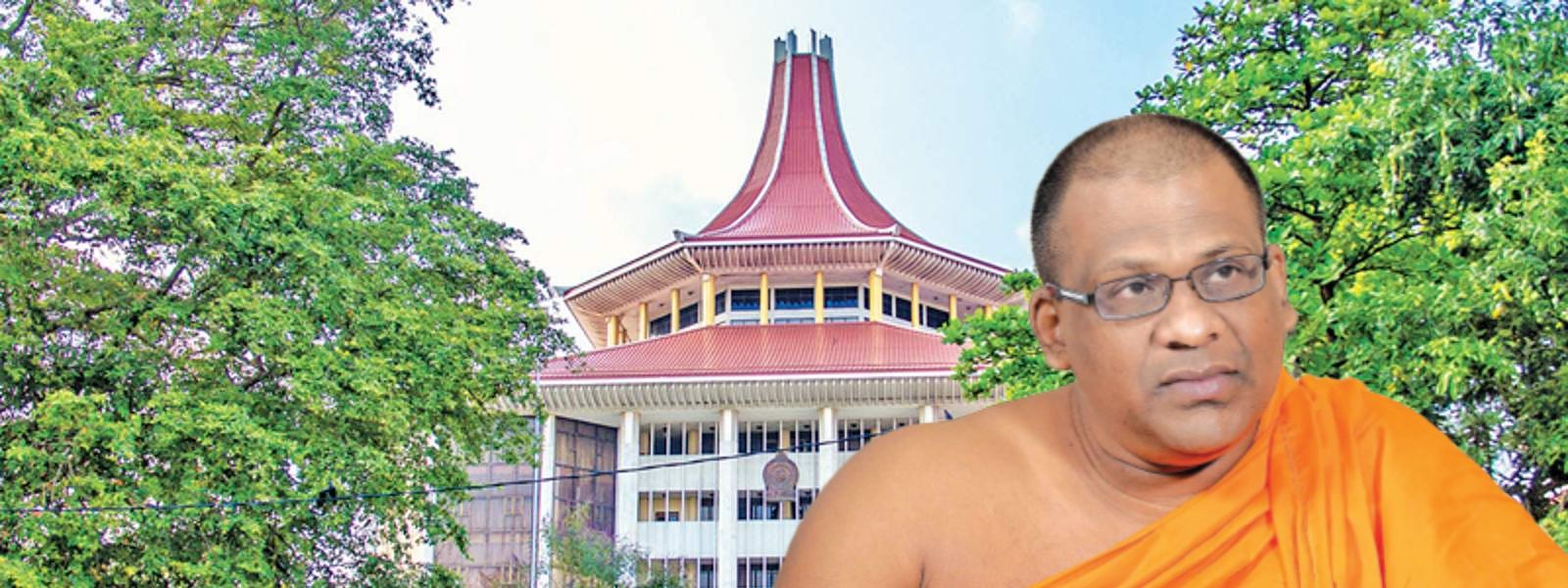
Supreme Court Rules Sirisena Acted Unconstitutionally in Granting Pardon To Gnanasara Thero



.png )
COLOMBO (News 1st); The Supreme Court has ruled to invalidate the Presidential pardon granted by former President Maithripala Sirisena to Ven. Galagoda Aththe Gnanasara Thero, the General Secretary of the Bodu Bala Sena organization, who was sentenced after being convicted of contempt of court.
The ruling was delivered following the hearing of a Fundamental Rights petition filed seeking a declaration that the Presidential pardon granted to the monk was unconstitutional and therefore invalid.
The Supreme Court delivered the decision while issuing its final judgment in a Fundamental Rights petition filed by a group of petitioners including Sandhya Eknaligoda, the wife of missing journalist Prageeth Eknaligoda, challenging the legality of the Presidential pardon granted to Ven. Gnanasara Thero following his conviction for contempt of court.
The judgment was delivered by Supreme Court Justice Janak de Silva, with the concurrence of Supreme Court Justices Sobhitha Rajakaruna and Sampath Abeykoon.
What is the background to this case?
The controversy originates from an incident that occurred in January 2016 during proceedings before the Homagama Magistrate's Court relating to the disappearance of journalist Prageeth Eknaligoda.
It was alleged that Ven. Gnanasara Thero had addressed the court without permission, disrupted court proceedings, and directed insulting remarks at both the judiciary and state counsel.
Accordingly, on August 8, 2018, the Court of Appeal found the Bodu Bala Sena General Secretary guilty on four counts of contempt of court and sentenced him to a total of 19 years of imprisonment, to be served concurrently over a period of six years.
Subsequently, former President Maithripala Sirisena granted the monk a Presidential pardon, resulting in his release from prison.
Why did the Supreme Court invalidate the pardon?
Delivering the judgment, Justice Janak de Silva held that former President Maithripala Sirisena had granted the pardon arbitrarily, without following the legal procedures and constitutional safeguards required when exercising the power of clemency.
The judgment states that the decision taken by the former President was inconsistent with the Constitution.
The Court further noted that the then President had relied solely on advice provided by an Additional Legal Secretary when granting the pardon.
The judgment emphasized that the decision to grant the Presidential pardon was arbitrary and violated both the Public Trust Doctrine and the principles of natural justice.
The Supreme Court also held that former President Maithripala Sirisena had acted beyond the proper limits of his constitutional authority and, in doing so, had violated the fundamental right to equality guaranteed under the Constitution.
Accordingly, the Supreme Court ordered that the Presidential pardon granted to Ven. Gnanasara Thero be declared null and void.
The ruling is the latest in a series of landmark Supreme Court decisions striking down Presidential pardons granted outside the established legal framework.
On 17 January 2024, the Supreme Court declared unlawful and invalid the Presidential pardon granted by former President Gotabaya Rajapaksa to former Parliamentarian Duminda Silva, who had been sentenced to death for the murder of Bharatha Lakshman Premachandra.
In another significant decision, the Supreme Court also ruled that the Presidential pardon granted by former President Maithripala Sirisena to Jude Shramantha Jayamaha, who had been sentenced to death for the 2005 murder of 19-year-old Yvonne Johnson, was unconstitutional and therefore invalid.
Other Articles

-854668_550x300.jpg)





Featured News




News 1st, MTV Channel (Pvt) Ltd, MBC Networks (Pvt) Ltd, 45/3, Braybrooke Street, Colombo-02.
T.P : +94 114 792 700, Fax : +94 114 792 733
T.P : +94 114 792 700, Fax : +94 114 792 733




 |  | .webp) |
|---|---|---|
 |  |  |
 |  |  |
 |
