.webp)


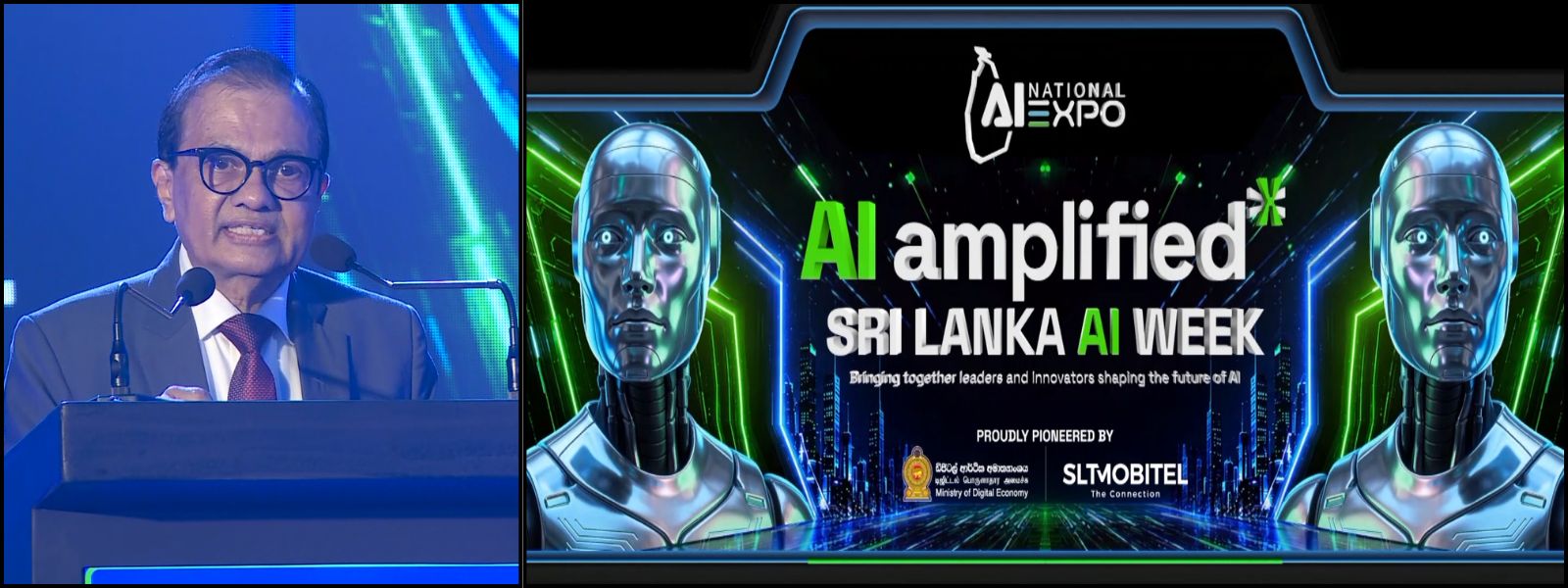
Can Sri Lanka Build Its Own AI Revolution? SLT Chairman Thinks So



.png )
COLOMBO (News 1st); As the global race for artificial intelligence increasingly resembles an arms race measured in trillions of parameters, billions of dollars and enormous data centres, Dr. Mothilal de Silva, Chairman of the SLT Group, believes Sri Lanka should take a very different path.
His message is simple, but potentially transformative: Stop chasing size. Start chasing impact.
Speaking about the future of AI in Sri Lanka, Dr. de Silva argued that the next chapter of artificial intelligence will not necessarily belong to the biggest models. Instead, it will be driven by smarter, more efficient and task-specific systems capable of solving real-world problems.
The comments come at a time when AI governance is rapidly emerging as one of the world's most important policy discussions. Countries across Asia and beyond are moving quickly to establish regulatory frameworks for artificial intelligence, reflecting growing concerns over accountability, bias, safety and privacy.
According to Dr. de Silva, the world is entering an era where AI is no longer viewed purely as a technological breakthrough but as a governance challenge.
"Who is accountable when an autonomous agent causes harm? How do we ensure AI does not perpetuate bias? How do we protect citizens' data while enabling innovation?" he asked.
"These are not academic questions. They are governance imperatives."
While global technology giants continue investing in ever-larger AI models, Dr. de Silva said Sri Lanka faces a more immediate challenge: infrastructure.
He pointed out that the country currently lacks the GPU capacity, hyperscale data centres and computational resources required to train large language models at the scale seen in the United States, China or Europe.
"This is our most critical gap," he warned.
However, he noted that efforts are already underway to close that gap. The Government has allocated billions of rupees toward AI and digital infrastructure, discussions are ongoing with global hyperscale technology companies, and SLT-Mobitel is preparing to upgrade its data centres to become AI-ready.
Sri Lanka has already laid more than 70,000 kilometres of fibre infrastructure, while fibre connectivity is expected to reach every secondary school in the country by the end of the year.
Yet for Dr. de Silva, infrastructure is only part of the equation.
"The future is not only about the biggest models, but the smartest, most efficient ones."
That belief forms the foundation of what he calls a "small is beautiful" strategy for Sri Lanka.
For years, the AI industry operated under the assumption that intelligence naturally increased with model size. GPT-3, for example, contained 175 billion parameters, while newer frontier models have surpassed the trillion-parameter mark.
But Dr. de Silva believes that assumption is beginning to break down.
Increasingly, smaller language models are proving capable of outperforming much larger systems in specific tasks, while requiring only a fraction of the computing power and operating costs.
For Sri Lanka, he says, that is liberating.
Rather than trying to build the next global AI giant, the country should focus on creating affordable, locally relevant solutions designed for its people, languages and realities.
Imagine an AI assistant that understands Sinhala and Tamil and helps citizens navigate government services.
Imagine farmers using AI-powered smartphone applications that work even without internet connectivity to diagnose crop diseases in the field.
Imagine rural clinics using AI-driven diagnostic tools to help identify medical conditions more quickly.
Imagine every student in the country receiving personalized learning support tailored to their individual strengths and weaknesses.
Those, according to Dr. de Silva, are the AI breakthroughs that matter for Sri Lanka.
"We do not need to build the next GPT," he said.
"We need to build practical, affordable AI solutions designed for our local languages and our infrastructure and our budgets."
At the heart of his vision lies a broader goal: ensuring that Sri Lanka becomes more than just a consumer of foreign technology.
In a world increasingly shaped by artificial intelligence, the challenge is not simply to use AI built elsewhere, but to create solutions that address local problems and generate local value.
For Dr. de Silva, success will not be measured by the size of a model or the number of parameters it contains.
It will be measured by whether artificial intelligence can help a farmer grow more food, a teacher reach more students, a doctor provide better care and a citizen access services more easily.
"Our goal," he said, "is a Sri Lankan-driven AI model that serves Sri Lankans first."
Other Articles
-857045_550x300.jpg)




.png)


Featured News




News 1st, MTV Channel (Pvt) Ltd, MBC Networks (Pvt) Ltd, 45/3, Braybrooke Street, Colombo-02.
T.P : +94 114 792 700, Fax : +94 114 792 733
T.P : +94 114 792 700, Fax : +94 114 792 733




 |  | .webp) |
|---|---|---|
 |  |  |
 |  |  |
 |
