.webp)


Could Sri Lanka Break a 43-Year Temperature Record?



.png )
COLOMBO (News 1st); The Department of Meteorology has warned that the heat felt by the human body could remain at elevated levels in several parts of Sri Lanka, as the country grapples with worsening dry weather conditions and growing concerns over the impact of a powerful El Niño phenomenon that is affecting weather patterns around the globe.
According to the Department, parts of the Eastern and North Central Provinces, along with areas in the districts of Jaffna, Kilinochchi, Vavuniya, Mullaitivu and Monaragala, could experience high heat index levels that require public attention.
Authorities have advised those working outdoors to drink plenty of water, take adequate rest breaks and avoid prolonged exposure to direct sunlight. The public has also been urged to wear light-coloured, lightweight clothing when outdoors in order to reduce the risk of heat-related illnesses.
While high temperatures continue to affect many areas, the Department of Meteorology said some relief in the form of rain is expected in parts of the country. I
ntermittent showers are forecast in the Western and Sabaragamuwa Provinces as well as in the districts of Kandy, Nuwara Eliya, Galle and Matara. Several spells of rain are also expected in the North Western Province, while showers or thundershowers may develop in parts of Ampara, Monaragala and Batticaloa.
The weather warning comes at a time when climate experts worldwide are monitoring what is expected to be one of the strongest El Niño events in modern history.
The Australian Bureau of Meteorology has projected that temperatures in the central Pacific Ocean could rise by as much as 3.6 degrees Celsius, with the strongest conditions expected around November.
Experts note that such a powerful El Niño has rarely been observed over the past century, raising concerns about its potential effects on rainfall patterns, temperatures and agricultural production across several regions of the world, including Sri Lanka.
Addressing a conference held at the National Science Institute, Senior Meteorologist Malith Fernando explained that Sri Lanka does not independently forecast or monitor El Niño conditions, but instead relies on forecasts issued by international meteorological institutions while comparing those predictions with the country's historical weather records.
Fernando stressed that people should not assume Sri Lanka's most severe impacts will necessarily occur in November simply because global El Niño conditions are expected to peak during that period. He noted that rainfall can still occur despite El Niño conditions and that various local and regional weather factors influence Sri Lanka's climate.
He further warned that global temperatures next year could reach record highs, increasing the possibility of extremely hot conditions in Sri Lanka. The highest temperature ever recorded in Sri Lanka remains 40.1 degrees Celsius, measured in Vavuniya on April 10, 1983. However, temperatures of 39.9 degrees Celsius were recently recorded in Pottuvil, bringing the country within just 0.2 degrees of its all-time record and raising the possibility that new temperature records could be broken in the future.
Meanwhile, the dry weather situation continues to worsen across Sri Lanka. According to official figures, seven districts have already been affected, with Monaragala emerging as the worst-hit district. The other affected districts are Ampara, Badulla, Batticaloa, Hambantota, Polonnaruwa and Ratnapura.
The Disaster Management Centre said 25,628 families, comprising 81,865 people, have been affected by the prevailing dry conditions. Of those impacted, 72,153 people from 23,048 families in 20 Divisional Secretariat divisions are currently receiving drinking water supplied by authorities.
Agricultural officials are also preparing for the potential impacts of El Niño on future cultivation seasons. The Department of Agriculture has indicated that plans are underway to commence the upcoming Maha cultivation season before October 15 as part of efforts to better manage available water resources.
Chief Agricultural Scientist Chandana Wickramatunga of the Natural Resources Management Centre stated that although El Niño is expected to have a greater impact on the 2027 Yala season than on current cultivation activities, steps taken now could significantly reduce future losses.
He explained that conserving water during the 2026/27 Maha season would be crucial to ensuring sufficient reserves for the following Yala season. Farmers have been encouraged to strengthen field bunds, properly maintain irrigation canals and effectively control weeds, all of which can help reduce water loss and improve water retention. He also pointed out that rising temperatures could pose an even greater challenge than reduced rainfall, as higher temperatures increase evaporation rates and accelerate water loss from agricultural lands.
The impact of the drought is already visible in several farming communities.
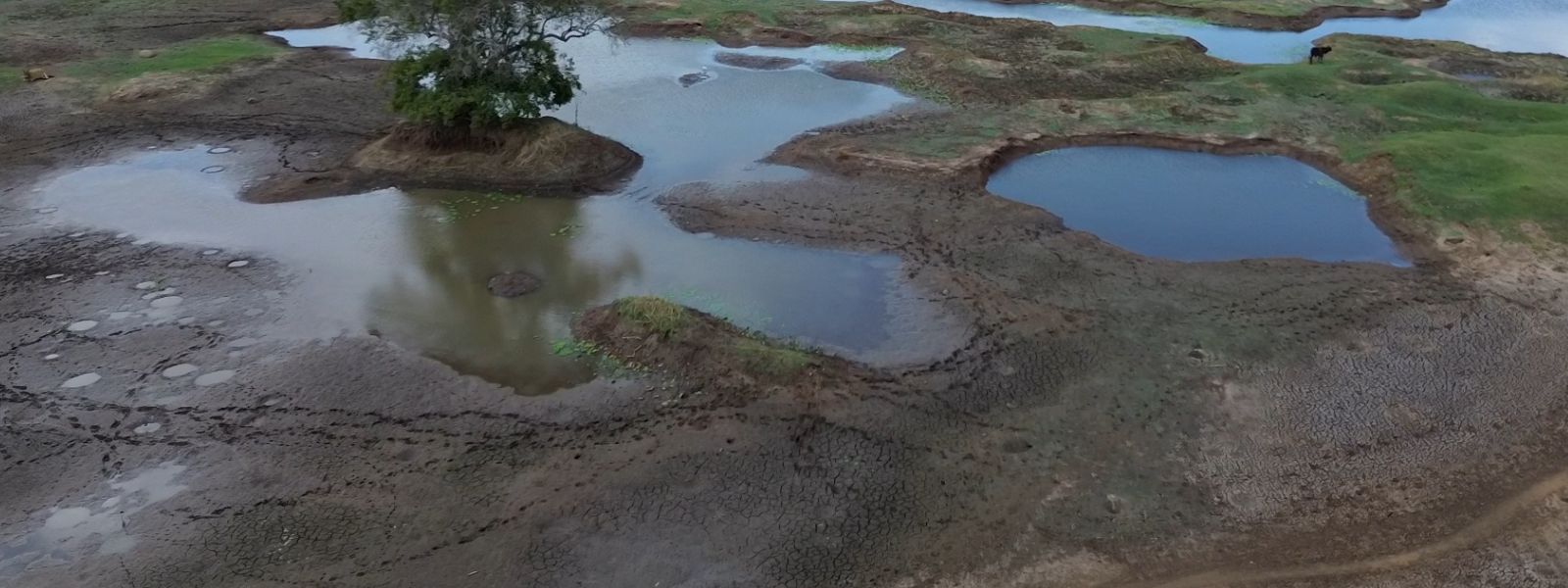
In Anuradhapura District's Mahawilachchiya area, the Kandurupitiya Tank in Alapathgama has been severely affected after months of dry weather. The reservoir supports more than 110 acres of agricultural land, but insufficient water has placed much of this cultivation under severe stress.
Farmers say they have been forced to abandon large portions of their fields due to water shortages. One farmer explained that out of five-and-a-half acres under cultivation, he had already abandoned three-and-a-half acres because there was not enough water to sustain the crops. Another farmer lamented that despite spending large sums of money on cultivation, extreme heat and inadequate water had prevented crops from developing properly.
Similar conditions are being experienced in the Thirappane Divisional Secretariat area, where the Thammannagala Tank has almost completely dried up, affecting around 12 acres of paddy lands. Farmers say entire cultivation plots have been abandoned after water levels disappeared rapidly.
The Manakkulam-Wagayakulam Tank in the same area has also dried up, impacting approximately 15 acres of paddy cultivation and leaving farmers demanding long-term solutions to recurring drought conditions.
The drought is not only affecting crop cultivation but also livestock farming. Dairy farmers in Anuradhapura say they are struggling to find adequate water and grass for their cattle. As a result, milk production has dropped sharply.
One dairy farmer said cows that previously produced around ten litres of milk per day are now yielding only three to four litres due to the lack of feed and water, severely affecting the livelihoods of farming families dependent on the dairy industry.
Water Supply Minister Dr. Susil Ranasinghe said around 10,000 acres of farmland have been affected by the drought, with some areas experiencing total crop losses.
The Minister stated that the Ministry of Agriculture and the Agricultural Insurance Board are currently assessing the damage and verifying affected lands. Compensation is expected to be provided to eligible farmers whose crops have been damaged or destroyed.
While authorities believe the cultivation season has largely ended and that further crop losses may be limited, drinking water shortages remain a major concern. Dr. Ranasinghe said water is currently being distributed by bowsers to large numbers of affected families, particularly in Ratnapura, Ampara, Batticaloa and Monaragala districts.
He added that the government has strengthened disaster management mechanisms and established a ministerial subcommittee to address the evolving situation, while President Anura Kumara Dissanayake is personally monitoring efforts to ensure assistance reaches affected communities.
Concerns have also emerged over whether prolonged dry weather could create challenges for the country's energy sector.
Responding to those concerns, Energy Minister Anura Karunatilaka said the government is taking proactive measures to strengthen electricity generation capacity. He revealed that a 160-megawatt battery energy storage system is expected to be connected to the national grid between October and December.
In addition, tenders have already been called for another 250 megawatts of battery storage capacity, while plans are also underway to secure an additional 150 megawatts through ground-mounted solar power projects. The government is further preparing initiatives to encourage larger rooftop solar power operators to install battery systems, including possible tax concessions for selected investors.
With one of the world's strongest El Niño events continuing to develop, the coming months could prove crucial for the country's farmers, households, businesses and overall economy.
Other Articles









Featured News


-849213_550x300.jpg)

News 1st, MTV Channel (Pvt) Ltd, MBC Networks (Pvt) Ltd, 45/3, Braybrooke Street, Colombo-02.
T.P : +94 114 792 700, Fax : +94 114 792 733
T.P : +94 114 792 700, Fax : +94 114 792 733




 |  | .webp) |
|---|---|---|
 |  |  |
 |  |  |
 |
